Showing posts with label Interview. Show all posts

Wednesday, May 5, 2010

Infinite/Undefined - an interview with Eurico Coelho


Seldom - if ever - was I given the pleasure of interviewing a fellow Portuguese personality whose efforts played a role of any relevance in the history of digital arts. Even if the subject of the present article is not diametrically associated with its genuinely interactive domains, there exists an unequivocal nexus binding this film to its contemporary game production. An object of quiet cult following such as the one revisited here today pairs with the most notable offspring of that same age of digital experiments in the quality of a film where every element is, invariably, composed from that common and celebrated basic unit we call pixel.

Incited by the author's long held fascination for cinema and photography, the birth of Apeiron benefited sufficiently from a series of favorable conditions that graced Portugal during the mid and late nineties - a period during which the illusion of economic, cultural and technological development remained particularly convincing. From its very first exhibition at the Lisbon's Expo '98, namely in the Sony plaza’s striking Jumbotron screen, the film managed to conquer the attention of numerous guests of an event defined by pervasive grandeur and innovation. Following its subsequent exhibition at the VideoLisboa festival, whose atmosphere was far more suitable for its proper appreciation, Apeiron embarked on a final European tour.

.
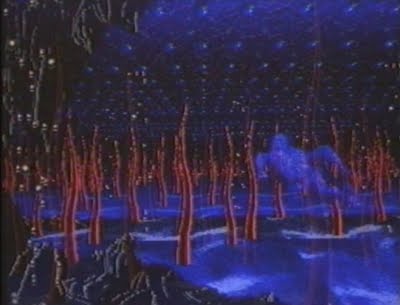


Of all the many venerable attributes it encloses, Coelho’s cult animation finds its greatest achievement in the combination of a technically challenging process – built, essentially, with the use of domestic tools – with an intellectual heritage that is of added significance to those best acquainted with Portuguese culture and its primary references. It is nevertheless evident that the director imprinted his work with the distinct signature of themes from Classical Antiquity, aptly weaved together with a fondness for sci-fi dystopias, surrealism and an array of popular culture allusions.

The interview that follows was conducted two years ago as a part of my own private research: the fact that it was not meant to be published should account for the terseness of some of its questions. It is my aim to shed some light on this otherwise obscure animation work and its author; while at the same time closing this chapter named CoreGamers.

------------------------------------------

- Where does the desire to create a film using the computer originate from? Might it have been in some manner influenced by similar initiatives, namely from the international community of Amiga computer users?

I was already involved in the making of "films" and animated photographic sequences using a HI-8 Sony camera - incipient experiences. The computer allowed me to improve and discover other technical and expressive possibilities so that I could manage my interest for moving pictures. I knew nothing about computers before purchasing the Amiga 4000, suggested to me by a friend that, knowing of my work, indicated me this machine for being more adequate to that I intended to explore. I also had access to the demos that were being divulged in my friend's game disks and found them rather curious due to their psychedelic nature and music interactions but those didn't constitute a decisive influence on my work.


- Apeiron was exhibited internationally in different festivals and other events, namely Lisbon Expo 98. In what circumstances did an amateur film production become a part of such a momentous event?

The animation department from Expo98 solicited some plastic artists and directors for original contents that could be shown during intermissions of spectacles scheduled to occur at the Sony plaza. I learned about this possibility and presented, like many others, some works to director Rui Simões who interested himself for Apeiron, granting a wage that allowed me to edit and produce the film in a professional studio.

The video was exhibited several times throughout the event. I took the opportunity and sent the film to VideoLisboa, having been selected once again. The exhibition in this international festival opened other doors and I received more invitations that allowed an interesting divulgation of this work in exhibits that took place in several cities of Europe (Barcelona, Madrid, Pisa, Strasburg, Paris and Berlin).

- Apart from its use and manipulation of computer graphics, Apeiron also employs photography and video. Which were the tools you used in order to create them - what were the most pressing limitations felt at the time?

Photography and video were technologies that I knew best, the computer allowed me to organize them and expand them. I especially used the DeLuxePaint software and sporadically other photographic image capture applications that, in sequence, formed the small animated clips. I also tried rudimentary 3D graphics applications, morphing and audio, compiling these experiences in numerous archives. The volume of tests grew and at a given point I had the majority of the pieces necessary to the creation of a possible narrative. The film grew by itself, without an predetermined intention, the group of loose parts started to connect and that was my game: to find the connection gaps and fabricate the pieces there were missing for a coherent narrative.

Technical difficulties were just the expected for a machine with a 120mb hard drive and a 4MB RAM memory that I expanded to the enormity of 8MB for the astronomical quantity of 40.000 escudos (200 euros) in 1996 - but these were not limitative to the creative development. I was dazzled by the operative possibilities and I had no near reference points, knew no one else doing this kind of approach, which led me to be carried away by the minuscule format in which I was allowed to work, without an exact technical notion of those limitations.


- Observing the film today, there are evident similitudes in the manipulation of graphics with the visual standards of certain videogames. The background and bitmap characters dynamics evoke the point-and-click adventure genre; the sequences in which the protagonist drives his car on the way to the metropolis also remind the scaling techniques used in many a driving games. Are these but casual similarities or was there, in fact, some influence from videogames you might have played at the time?

My references relate to animation cinema and musical videoclips, as the games failed to interest me, seen that the audiovisual experimentation constituted itself as my formal and semantic game/amusement. The Amiga computers were the most adequate machines to play and for that reason they offered improved operative possibilities for audiovisual creations - that was my interest. The formal similarity between my films and the interactive games is merely circumstantial, although I admit that the sequences and narrative model do have strong connections with that universe, seen that my working process is similar to a game, with puzzle pieces that might formulate or solve enigmas.

- Do you recall any particular comments or reactions about the film from all of its national and international exhibitions?

I never obtained an enthusiastic reaction to the public to this work, it is not a format or story with the conditions to please the great public; however, I got very positive and respectable opinions from some foreign directors of which I underline two that collaborated with artists that, for me, are very important as David Cronenberg (The Fly, eXistenZ, Crash) or Marc Caro (Delicatessen). I've also obtain some negative reactions that considered Apeiron to be cold, disenchanted and unpleasant for an animation movie.


- In spite of its short duration, Apeiron alludes to a plethora of different themes: what are the roots of its narrative and to what extent was it determined by the tools you employed during the creation of the film?

The film began as a mere group of experimental sequences of cyclic movements or loops. As these pieces (anim-brushes/movie clips) multiplied, an imaginary began to emerge, demanding other pieces and details. The primary sense that began sketching itself pointed to a voyage, throughout which a little tin man (a sterilized action man) would be confronted with places and situations that would demand him to make decisions. Little by little, I felt the need to improve on his initial context, the group of obstacles and objectives to conquer. Thus I built him a house, gave him a wife (a real woman), a screen in front of him, a vehicle and a bird pet. In this trivial portrayal, I thought that the television in front of him could feed his dissatisfaction and beckon a group of trials that would provide importance to his self and to his ego, weakened by the commonplace quotidian.

The voyage made him go through different stages of an initiation, cities filled with beings just like him (anonymous), labyrinths, ascetic temples, social gears, contests and finally the conquest of success - the confirmation of his place in History. The Empty that he found on the other side of success allowed him to grasp this sterile world in colors, where he came to see a primordial and feminine ocean in which he dove in the search for a place in the memory of times.

The Well where he dove even further took him to the genetic and cultural roots of his dissatisfaction. His thousands of ancestors, trapped in an ENCYCLOPEDIA closed in Earth's archives revealed his destiny and the irrelevance of his quest. It was then that I found a similitude between his course and Plato's "The Allegory of the Cavern" and, therefore, I decided that he would return home but by doing it he could no longer occupy the place he had left - for that would be filled with the little color-blind man that saw television - a role to which he could not return to anymore. He had definitely entered the televised fiction with his example, to seduce the incomplete egos of others, like him, to search in life more than life has to offer.

This ended up consolidating itself as a story of the defeat of primal wishes of all those who seek success and reach it, imposing ther example on others. Far from a pleasant story, or an easy one to tell, it was the one that was born from the process that I initiated and I accepted it for its accuracy and naturalism. The means that I used were decisive to characterize, through smaller cycles of movement, the great cycle of which Apeiron is constituted. The film ends where it had began and can repeat itself as a looping metaphor, a race without origin nor purpose, like the small cycles that form it and made it grow.

It was never my intention to over impose or over illustrate that which the spectators ought to read from this film: this was my version because I thought for a long time and that constituted my safeguard interpretation; but I would like to leave others with the liberty and responsibility of interpreting it, according to their own sensibilities and subjective life experiences.


- Bearing in mind the revivalism we observe today, as well as the internet phenomenon and its divulging potentialities, works like Apeiron were brought new life among the members of the nostalgic Amiga community and multimedia design or digital art aficionados. In Portugal, Apeiron still holds an almost unique status, which makes it the more rare and precious. How do you remember this your work in the light of the context in which it originated?

Apeiron was, without doubt, my first great exploratory work. I dedicated it almost three years and learned much from it, but others followed with equal involvement: the L'Egoland process that followed it took me nearly two years of my time and never got to e concluded because the machine crashed and the technical assistance went broke. The standardized technology that succeeded the Amiga computers never matched the plasticity, performance and economy of resources that it possessed. I have nurtured the conviction that the technological progress is operated at the level of the immediacy and the speculative business and not the technical quality and design.

In what concerns the rarity of that small movie, I feel naturally surprised and flattered. But I understand the curiosity that constitutes the existence of a film built throughout a period of three years by a lone madman who worked in absurd technical conditions in comparison to actual standards - only to obtain 15 minutes of animation that don't exceed 70 MB, that ended up premiering on the Jumbotron of the largest event in Portugal at the time, before an international crowd of thousands of spectators. Seems like a fairy-tale. On the other hand, the pixelization effect also grants it a vintage look, that today acquires a special statute on account of its genuinity, that adding to its archaeological interest.


However I'm not one to indulge in remembrances or revivalisms since I keep on working in this sort of things with other challenges and limitations. I keep participating in festivals and shows and collaborating with other artists like the Teatro do Mar, the electronic publisher Thisco or the music band Moonspell in the animations projected during their shows. I also had the honor to participate in the presentation of the European Culture Capital 2012 in Guimarães with film projections mapped in architecture and my films have been shown across Europe and America, not to mention my activity as a multimedia professor in a high school. Apeiron marked the beginning of this course and the reason why I don't feel entirely realized with all this is because I find many faults in everything that I've done and I consider that I still have much to learn.

[ Watch APEIRON ]

Thursday, April 8, 2010

My 2009 OST Selection - Interview with Tomáš "Floex" Dvořák

Videogame historians and researchers will look back to 2009 not as a year of emergence but as a year of consecration of the independent game movement. As the market of commercial game becomes increasingly bland in its infinite recurrence of what has already been reiterated for too long, the need for autonomous and liberating interactive designs has risen precipitously. And while the larger productions have moved the cogs of technical excellence forward another quarter of a measure, ultimately it was raw creativity that ushered in the images and sounds for which the turn of the decade shall be remembered. Regarding musical compositions, a feature present in most games that is seldom given due appraisal, 2009 was a year dominated by abrupt contrasts between the outsized investments that allowed for orchestras to gather and play some of the most sounding videogame soundtrack themes, as in the outstanding participation of the top-class Hollywood composer Hans Zimmer scoring a multi-million dollar war game design; and between the undersized amateur or semi-professional studio work led by lone music composers that have adorned the small budget enterprises with their suggestive themes. Such was the case of Tomáš "Floex" Dvořák's musical accompaniment for the most triumphant adventure game of recent memory, Machinarium.

One of the most appealing environmental puzzles within Machinarium consists of returning these depressed street musicians their missing instruments so they can carry on enjoying their jam.

Using science fiction motives as a cloak to disguise irony and sporadic existential reflections, Machinarium speaks openly about human condition and technological progress without the use of a single word. Deriving from the minds of painters, designers and animators, its expressive qualities rely mostly on the universally interpretable gestures as depicted in each carefully crafted animation. Given the deliberate absence of voice, the metal cityscape of the game warranted a powerful aural milieu enabling a rare aesthetic balance between visuals and music. The most desirable quality about Floex’s music derives from the intense personality he bestowed to his reverberating tune, each very distinct from the next: the rhythmic plurality is strikingly noticeable in between the themes The Black Cap Brotherhood or Clockwise Operetta and The Bottom, where the percussion instruments are most evident; contrariwise, Dvořák (pronounced DVOR-zhack) also reduces the use of drumming to the point of nullity as can be verified in themes like The Sea and The Glasshouse with Butterflies. Bearing the clear sound signature of digital instruments, Machinarium’s soundtrack reveals erratic patterns of analog instruments that are underhandedly used throughout the game, as if an audible supplement waiting to be unveiled.

Excerpt from the theme "The Sea" that plays for the first time in the game when the first open venue of the city's interior is revealed.

Conscious of the quality of their work, Amanita Design has released this soundtrack to the public on several occasions, initially providing a selection of themes to customers who pre-ordered the game, later releasing it in Compact Disk quality together with the boxed version – released in only a few European countries. Recently, Minority Records has issued a limited edition of Floex’s defining work in the form of an autographed and hand-numbered LP (only 555 copies produced) that came both in classic black and transparent yellow vinyl. By no means an extravagance, this release was intended to be a celebration of Amanita’s crowning work, the spiritual successor to the SAMOROST series who had earned the studio a grand new status in the field of videogame creation. As a celebration of my own to one of the most intrepid videogame experiences I’ve ever witnessed, I’ve invited Floex for a brief interview where, I hoped, he could help me understand the trials he faced during the composition of a soundtrack designed specifically for an independent game: this was, after all, one of the most electable musical moments of last year in my humble opinion.

------------------------------------------

- Due to a large majority of English or North-American games that founded and supported point and click adventure genre through the years, it becomes very hard to evade those references when creating game outside those countries. One of the factors that seem distinguish Machinarium relate to references of its own, well outside the usual domains of adventure – almost as if the fact of being a Czech game design, not to undervalue the studio’s unbelievable talent, was at the root of its originality. How has your own cultural references influenced the composition of the music for Machinarium?

TD: Yes I think reference is more local based and it is not in the game context. That's probably the source of the originality. I see it more in the Czech animation tradition context, which is believed to be taken as pretty strong here in Czech republic. Trnka, Bojar and so on... and in a way Machinarium could be taken more as kind of interactive animation movie also considering the fact how it was made.

As for the music my influence is very wide. Most of the music comes from the electronic or electroacoustic scene and here I don't see any geographical reference. Lusine, Beaumont Hannant, Arve Henriksen, Apparat, Vladislav Delay, Fennesz, Clark, Jon Hopkins, Riyuichi Sakamoto, Grizzly Bear, OTK, Vladimir Vaclavek, Deerhoof, Thom York, Mark Hollis, Steve Reich, Portico Quartet, Hakon Kornstad. This is sort of music which for sure formed my own musical language beside endless chats with my musician friends.

The main character, Josef, was named for the sake of Josef Čapek (brother to Karel Čapek, creator of the play Rossum's Universal Robots) the original inventor of the word Robot.

- The soundtrack provides the listener several contrasts between lively and playful themes and others whose nature is certainly more stark and austere, made to match some of the greyer areas of the machine city. To what extent was the composition of the music affected by the design of the game and its visual expression?

TD: I think I was just trying to catch the mood of the image. On the other hand it is true I don't like too straight emotions in the music I think I am looking for the certain level of the deepness. - The Machinarium gameplay experience is based, among many different aspects, on puzzle solving. It seemed to me that whenever those hard abstract puzzles were presented, the music choice would fall on a theme that was less compelling and moody; somehow much more distant in space than when the game presented context puzzles involving character interaction, where the music themes are more poignant and discernible. Was this a conscious decision from your end?

TD: Yes, we have been discussing several levels and the need to give space for the player's thoughts. But often it is compromise between the other aspects of the each particular game level - the meaning of the level in the whole, the mood, the action what takes place there. - I was particularly enthralled by one of your compositions: the theme «The Sea», whose appearance in the game is a perfect complement to one of the first open venues from within the robot city, introducing the element of water. Please tell me more about the composition process and origins of this particular theme.

TD: Before Josef comes into the "Sea level", story takes place underground and scenes are scarier. I was trying to give more melancholic and moody feeling to the music in these scenes. In contrast to this Sea was considered as kind of bright and caressing music. Like when you see sun after long time and you are happy for the beautiful day. I was trying to make the music floating like waves. It is based on the orchestral motives which are processed through some of my favorite effect patches - I was looking for this ambient electro-acoustic feel.

Picture of Floex's humble but extremely tidy studio.

- It is customary for the adventure game genre to reduce the importance of musical composition given the fact that most of those games rely on massive dialogues, often voiced, that supersede the music playing on the background. How has the absence of any voices or text in Machinarium increased your responsibility in the process of composition and design of the game?

TD: This is for sure positive aspect for me because every new layer in the user perception takes some space for your own expression - image, music, sounds, speech, and interactivity. So I was freer with the music I could focus more on detail. Still trying to be more abstract and minimalist of course as the music doesn't stand on its own in the game. I have been carefully looking for the border to not to overcharge the image.

As illustrated by this picture, Dvořák went to lengths in order to acquire the distinct sonorities that made his work exceptional and worthy of such universal praise.

- It is often said that musicians, of all participants in the creative process, tend to take a passive stance during design – often given materials they can use to compose on their own time, desynchronized from the rest of the team. Your relation to Amanita and its team appears to be much tighter, and your participation much closer to the core of the game creation than usual. Please tell about your method of work during production.

TD: Yes we have little bit different approach. On one hand we all work from our places, we don't share some office. Everything is solved by ICQ plus meetings which are more friendly-based. I mean we don't purely solve the gaming issues when we see each other. I am really thankful for the people who are in Amanita, they are simply cool, very interesting personalities. I guess that just describes Jakub's character and his sensitivity for the people, he has been putting us together for quite time... As for the workflow on the daily basis: Jakub gave me freedom and his notices well mostly more like suggestions, he just believed to what I do and I have been trying to listen to his opinions carefully. I know it might sound like fairy tale but it really is like this in Amanita.

- In the field of videogames, visuals often take the lead in comparison with other basilar aspects of the game such as narrative, controls, gameplay and even soundtrack. In the case of Machinarium, the game comes with a very powerful visual component due to its exquisite backgrounds and animations: to what extent was that an additional responsibility to you – to create music that would live up to the visible spectacle of the game?

TD: Well I didn't definitely feel any pressure. I suppose all of this is just more inspiring and it stimulates my musical creativity.
The yellow-tinted version of Machinarium's LP soundtack edtion.

- First with the major success of the download-version of your soundtrack; and now with this special edition version in LP, it is safe to say that many people have not only taken notice of your work, they’ve also praised it with the highest remarks. How has this particular work influenced your career?

TD: I would say it was invisibly super important for me. I am actually person who is quite critical to my and the others work too. It is good feature only to some extent. On one hand it can stimulate you for the best results - you have to see what can be improved but on the other hand it can destroy your playfulness and the enjoyment trough the creative process. Anyway as I sometimes doubt about my musical qualities and for sure the Machinarium gave me more self-confidence to continue my musical journey. I was also happy for the personal people responses and linkage with the other musicians who wrote me.

[ Read Also: Machinarium Preview article @ Adventure Classic Gaming / Machinarium LP & Machinarium Collector's Edition Pictures / Unreleased Jakub Dvorský & Adolf Lachman Machinarium Artwork / My 2009 OST Selection: Interview with Vasily Kashnikov ]

Friday, October 30, 2009

Without further ado: Haruhiko Shono


How hard it is to manage a website - a network of internet contents - on one's own. CoreGamers begun as a project where different sorts of articles could be inserted, from modern to retro gaming, from purely nonsensical delirium to the rigor of profile and interview articles. Of all the plans and expectations I deposited in that site, together with the absent co-founder, I have only been able to carry out the one which I think to be most important; the one where I am able to contribute with a small amount of information about creators who, in spite of their importance to the field of videogames, are not usually taken into consideration by mainstream media.

Some months ago, I advertised the rare chance I was given to interview Haruhiko Shono. As mentioned in the Profile and Interview article I publish today, his name might not be of importance to the witless videogame players of the current generation. I'm sure that even older generation players will have a certain difficulty in associating his name with an actual game title. But one single word, as if by magic, might help telling apart those who truly admire the art that exists in videogames and those who claim to the industry from inside out: and that word is GADGET.

Other relics from times past make their appearance in the article; the ethereal ALICE, one of the first interactive works to appeal to the love for Arts; and L-ZONE, in which the author expresses his matured admiration for video art, machinery and the coming of the digital age. Exceptionally, I've also prepared a long gallery of media to support the article: apart from the unreleased projects, published in the parent visual blog Pixels At An Exhibition, and the several materials I've been publishing for the last months, there will be high quality videos documenting his major creations. Given the fact that the Internet has been rather useless in the research for information concerning this admirable videogame designer, I felt the necessity to bridge the gaps and provide a substantial - while not definite - account of his career and the creations that define it.

This was by far the hardest research project I've dealt with in the last months, although it is extremely rewarding to receive such a positive reaction to the article from Shono himself. And it is at times like these that I understand more clearly that all this work is not in vain: it is an opportunity to learn and to pass that knowledge to others. Lastly, I would like to renew my acknowledgement to Sorrel Tilley whose help in the translation department has proved essential to the fulfilment of this personal goal - and to the many others, friends and strangers who have supported me in the completion of this piece.

Friday, August 14, 2009

Insanely Twisted Shadow Planet - Interview with Joseph Olson (Fuelcell Games) and Michel Gagné

INSANELY TWISTED SHADOW PLANET is an independent Fuelcell Games project being produced with the collaboration of the renowned cartoonist and animator Michel Gagné. In spite of his previous work in the field, this is the first venture where the Canadian artist is actively participating in the process of game design. The Seattle based studio is working on a very peculiar adaptation his series of interstitials entitled Insanely Twisted Shadow Puppets, consisting of brief, dark-humored segments of high-quality digital animation.

ITSP presents an incredibly smooth vector graphics environment - as seen in the recent HD trailer - where the player controls a vintage 1950’s flying saucer in the battle against an oppressive force of bizarre creatures inhabiting the obscure planet. Both Michel Gagné and Joe Olson, from Fuelcell studios, were kind enough to answer some of my questions for a brief interview regarding the production of this highly original reinvention of the old shoot'em up game genre.

CoreGaming | Mr. Gagné, given your wide experience in the fields of cartoons, comics, concept art, animation, cinema and television, it was rather surprising to learn that you had never participated directly in the creation of a videogame: how did the idea to adapt one of your animated features to this new format originate?

Michel GAGNÉ | About three years ago, I met Joe Olson at an FX workshop I was giving in Seattle. Shortly after, Joe emailed me and said that he’d love to do a videogame project with me. We met for lunch and started brainstorming about some ideas. I told him I had virtually no experience working in games, and to my surprise, he replied that it was a good thing. His thought was that the game industry was in need of fresh ideas and an industry outsider who has a strong artistic style could bring something unique to the table. I didn’t know much about the game process so it became a new challenge that I embraced with great enthusiasm.

Joe mentioned to me that we should do a game based on the design of a series of interstitials called Insanely Twisted Shadow Puppets I created in 2005. That was the starting point.


Joseph Olson at the Fuelcell studio space.

CoreGaming | Judging by the video presentations, ITSP seems to be a very ambitious project. Could you tell me more about the production team and the sort of technologies you're currently using?

Joseph OLSON | We started with Torque Game Builder, mainly because it was geared towards 2D game creation, allowed us to mix 3D assets in with the 2D in a convincing way, and most importantly it is fairly cheap for a source code license. Over the course of preproduction we’ve made various improvements and alterations in order to increase productivity and get the desired results.


The team here at Fuelcell is comprised of a handful of industry veterans - myself being in the industry for about 12 years now. Basically a bunch of guys in the Seattle area I've worked with over the years, as well as some newer folks brought in especially for this project. A good portion of us come from the special FX side of things, which is why creating a game with Michel made so much sense. Like most small independent studios these days we have taken on a lot of contract work for other games to keep the money flowing and the team together.

CoreGaming | I've read that the game is planned for release in multiple platforms: how is it like negotiating the game with different manufacturers?

Joseph OLSON | As we're still in negotiations, it's tough to answer this question. We're talking with a lot of different publishers right now and they all have slightly different visions for which platforms our game would appear on. We do wish to put this on as many platforms as makes sense, with the HD platforms (360 and PS3) being the main focus.


CoreGaming | Independent games abound at present. Everyday we witness the release of yet another independent title: some of them based on uprecedented concepts, whereas others are essentially modern-day homages to classic videogame titles. What do you think are the most innovative and interesting features in ITSP and to what audience are you aiming at?

Joseph OLSON | While the biggest feature is obviously Michel’s style and fluid feature quality animation at HD resolution, we’re very excited about our zoom technology, which allows us to zoom in or out in a given environment while keeping the resolution sharp. We first used it in our splash screen menu but have since started experimenting with using it in gameplay. One example I can give at this time is a viral attack game. Your UFO is attacked by a cloud of viral entities, at which point the camera zooms incredibly far in on the surface of your hull, where you then take control of a white blood cell type craft and have to frantically sweep up the virals before they infect your UFO. The transitions to and from this nano game and realtime are really quite impressive.

We're lucky to have a wide ranging audience for this game. Michel's stark art style appeals across age groups, casual and core gamers, as well as internationally. It's not often a western artist is so well received in the east, so we're fortunate in that respect. The development team grew up playing classic arcade and console games, so the gameplay is heavily influenced by games like MEGA MAN, R-TYPE, and the like.

CoreGaming | Is there a release date in your mind at the moment?

Joseph OLSON | No release date as of yet, stay tuned to the official blog for more news on that front in the coming months!

Wednesday, July 29, 2009

What lies beneath


Edge Online published a rather interesting interview with Yasuhiro Wada, the former Natsume prodigy who created HARVEST MOON, now chief officer in Marvelous Entertainment. Some days ago, Wada has posted a highly controversial message in the company blog stating how the Japanese gaming market is shrinking and has lost touch with the demand for quality and originality. In spite of the negative responses to this statement, the fact remains that for the first time in years, an agent of the industry has recognized that the current lack of innovation in games has driven away many of the passionate players from older generations.

Marvelous Entertainment has been responsible, among others, for some of the best Wii and DS releases of recent memory, from NO MORE HEROES to OBORO MURAMASA YŌTŌDEN, including LITTLE KING'S STORY and LOL (ARCHIME DS): additionally it has developed intimate relationships with some of Japan's most notable studios like Grasshopper Manufacture, skip, Cing, Town Factory or Arte Piazza.

However the company still struggles with financial drawbacks which often come as a surprise in light of the positive reception from critics. As an expert in his field and a person who seems to be aware of the subtleties leading to the actual state of gaming in Japan, Wada presents a rather challenging series of opinions: furthermore, judging by his company’s clean record and increasing relevance in the actual market, this is a rare case where the theory about exploring new fields of game design is effectively backed up by practice.