Friday, October 30, 2009

Without further ado: Haruhiko Shono


How hard it is to manage a website - a network of internet contents - on one's own. CoreGamers begun as a project where different sorts of articles could be inserted, from modern to retro gaming, from purely nonsensical delirium to the rigor of profile and interview articles. Of all the plans and expectations I deposited in that site, together with the absent co-founder, I have only been able to carry out the one which I think to be most important; the one where I am able to contribute with a small amount of information about creators who, in spite of their importance to the field of videogames, are not usually taken into consideration by mainstream media.

Some months ago, I advertised the rare chance I was given to interview Haruhiko Shono. As mentioned in the Profile and Interview article I publish today, his name might not be of importance to the witless videogame players of the current generation. I'm sure that even older generation players will have a certain difficulty in associating his name with an actual game title. But one single word, as if by magic, might help telling apart those who truly admire the art that exists in videogames and those who claim to the industry from inside out: and that word is GADGET.

Other relics from times past make their appearance in the article; the ethereal ALICE, one of the first interactive works to appeal to the love for Arts; and L-ZONE, in which the author expresses his matured admiration for video art, machinery and the coming of the digital age. Exceptionally, I've also prepared a long gallery of media to support the article: apart from the unreleased projects, published in the parent visual blog Pixels At An Exhibition, and the several materials I've been publishing for the last months, there will be high quality videos documenting his major creations. Given the fact that the Internet has been rather useless in the research for information concerning this admirable videogame designer, I felt the necessity to bridge the gaps and provide a substantial - while not definite - account of his career and the creations that define it.

This was by far the hardest research project I've dealt with in the last months, although it is extremely rewarding to receive such a positive reaction to the article from Shono himself. And it is at times like these that I understand more clearly that all this work is not in vain: it is an opportunity to learn and to pass that knowledge to others. Lastly, I would like to renew my acknowledgement to Sorrel Tilley whose help in the translation department has proved essential to the fulfilment of this personal goal - and to the many others, friends and strangers who have supported me in the completion of this piece.

Monday, October 12, 2009

Leaps of Faith - Eric Viennot interview with Jordan Mechner and Eric Chahi


One of the most fascinating aspects of videogame history concerns the spiritual nexus that unites Jordan Mechner and Eric Chahi. Working in completely different rhythms and proportions, not to mention in opposite sides of the Atlantic, their creative stance has resulted in fairly similar works given the context of their release, especially with the case of PRINCE OF PERSIA and ANOTHER WORLD. While Mechner's game was published two years earlier, Chahi has recently claimed that, at the time he created his masterpiece, he wasn't aware of his North-American counterpart's work. Considering Chahi's answer to this old question as a truthful retortion - and there is no plausible reason to question its integrity - then we are in the presence of a true videogame phenomenon.

The idea of uniting Mechner and Chahi was suggested on several occasions as the critical solution to this ancient conundrum that would confront and dispel all of the enduring myths. Making this long-held daydream a reality, the two creators were interviewed by Eric Viennot, the co-founder of the French studio Lexis Numérique and the creator of the cult classic IN MEMORIAM (see profile and interview by CoreGamers on February 2007).

An authority among France's most prodigious adepts of digital arts, Viennot is also very keen on videogame culture. Surprisingly, as explained in the introduction to this first part of the entire dialogue, the interview resulted from Jordan Mechner's initial request for help in establishing contact with Chahi. Seizing this exceptional opportunity in the role of an intermediate, Eric Viennot has drafted a number of stimulating enquiries regarding each of the interviewees’ perspectives and motivations through the course of their careers. Apart from providing a definite confirmation that Eric Chahi is involved in the creation of a new project, this interview is unquestionably one of the most important documents related to this peculiar chapter of videogame history.

Wednesday, September 30, 2009

L'Histoire de Nintendo #2 - The birth of Yokoi's Micro Game legacy


Pix'N Love Editions is a French publisher specialized in creating and editing videogame books. Among dozens of issued works, concerning different companies and systems, L'Histoire de Nintendo is without a doubt their largest and most admirable endeavor. The two existing volumes of the series consist of the unmistakable result of a thorough and obsessive investigation, possible only on account of a great investment, as well as the unofficial participation of Nintendo personalities, interviewed during the course of the project. Whereas the first tome provided an absorbing account of the earliest roots of the Kyoto based company, #2, as hinted by its title 1980-1991 L'étonannte invention: les Game & Watch, explores the rise and expansion of Nintendo's first handheld system, envisioned by the late Gunpei Yokoi.

Codenamed Micro Game during its prototype phase, the Game & Watch system used a technology similar to that of dentaku (Japanese pocket calculators). Unlike its best-selling successor, the Game Boy, the G&W did not work with interchangeable cartridges and so the creation of each new game resulted in 59 unique systems released within a period of almost ten years. The Japanese phenomenon was later brought to different countries around the world, waging a battle against the predictable appearance of numerous replicas and clones – surprisingly featured in the book - that sought to cash in the portable LCD game vogue. In spite of the earlier efforts led by North-American companies such as Atari and Milton Bradley in the foundation of a handheld console market, it was Nintendo’s name that would become the universal epitome of portable gaming, a tradition that endured until this day.

With this second volume, author Fiorent Gorges and his aid in Japanese territories, Isao Yamazaki, have composed an overwhelming and wide-ranging document: not the smallest detail was disregarded in this compilation, including Yokoi's first experiments, unseen sketches of early models, detailed information of every Game & Watch series, advertising materials, official variations, byproducts and recent re-releases. Each of the 194 pages, printed in full color and extensively illustrated with the highest quality, is a heart-felt homage to one of the supreme geniuses of the industry whose tragic death resulted in the premature conclusion of a notable career. Written in an objective and passionate style, the latest volume of this succession is, to the lack of a better expression, the ultimate resource on the history of Nintendo and a paradigm of videogame publications.

More information on how to purchase this book can be found at the official website. For non-French users, please consult this brief tutorial on how to order.

Monday, September 28, 2009

It is a riddle, wrapped in a mystery, inside an enigma.


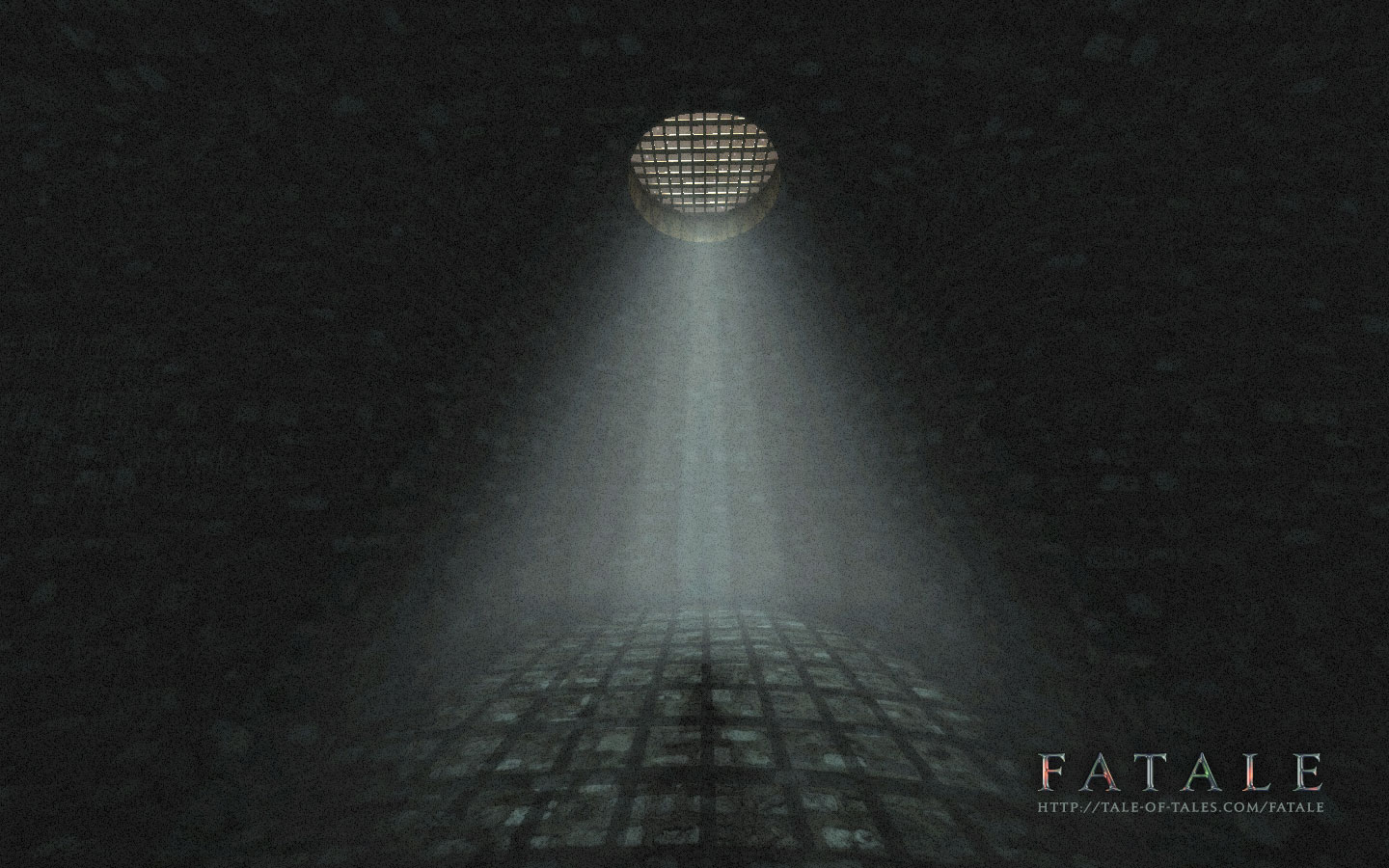
One week away from its release, FATALE remains a great mystery. While briefly described by its creators as an interactive vignette, no detailed information concerning its interactive system, scheme or genre was provided yet. Presented as a project of a similar scale to their previous avant-garde 2008 work, THE GRAVEYARD, FATALE has already summoned the attention of many a videogame enthusiast after Tale of Tales announced the official participation of Takayoshi Sato, of SILENT HILL fame, in the role of Character Designer.

All efforts have been made so far in order to conceal vital information regarding this upcoming title: the release of an audio trailer today is a clear statement that Tale of Tales wishes to preserve such secrecy until the fifth of October. As a follower of the official blog and an avid reader of all posts, it seems rather suitable that the promotion is being handled in this particularly awkward fashion, given the game designer's interest of late for sound novels and other alternative game designs. Already it is possible to verify the quality of the exotic soundtrack, aptly created by Gerry de Mol, of the vibrant sound effects, designed by Kris Force, as well as the sensuous voice acting and unique musical talent of Jarboe.

Based on Salome, the 1891 Oscar Wilde play depicting the events that lead to the beheading of John the Baptist at the request of the dancing temptress, FATALE should be regarded as one of most important indie events of this year for several plausible reasons: not only it is the first work after the release of the sensational THE PATH, selected as finalist in different game award festivals, as it is a rare gathering of specialists in different areas of digital content production. What is more, the selection of such an erudite theme - a direct consequence of Auriea Harvey and Michaël Samyn's desire to explore mature contents in the field of digital games - altogether with the exquisite artistic skills shown in the past by the studio, will surely to bring about a controversial and equally memorable experience.

More information can be found at the
official site.

Friday, September 18, 2009

Machinarium sneak preview @ ACG


Quite the masterpiece. As MACHINARIUM is nearing its completion, I've written a thorough preview article for Adventure Classic Gaming based on my personal experience with two different builds of the game. This should come as no surprise to anyone who is familiar with SAMOROST: Amanita Design, an exceptionally talented ensemble, has managed to create one of the single best adventure titles of all time in what is their first attempt at a full-sized production.

The regal aesthetic sensbility and exquisite visual design, undeniably
one of the Czech studio's staples, are merely the first of many accomplishments: its storytelling methods confront years of adventure game design canons; Thomas Dvořák, making justice to his own name, has composed a transcending, expressive and highly atmospheric soundtrack that succeeds in intensifying the unique experience; additionally, there is something of an unprecedented poetic beauty to the very act of puzzle solving.

Contrasting with the tedious and mind-numbing spiral of reiteration and recycling that defines the recent history of the adventure genre, Amanita Design led the project with unusual creative vigor and maturity. By carefully managing its own references and inspirations, MACHINARIUM achieves a rare state of equilibrium between an alternative legacy of videogames, eastern European animation, science fiction literature, silent cinema and twentieth century plastic art. All this will become available for download somewhere in the fall of this year.

Also be sure to take a look at the exclusive sketches and artworks gallery, authored by Jakub Dvorsky and Adolf Lachman, that I published in the parent blog Pixels at an Exhibition.

Thursday, September 17, 2009

Trip like I do


DETUNED was released just moments ago in the PlayStation Store. Sold for a symbolic price, this is the best and only existing alternative to Q-Games' GAIA in the category of dynamic music visualizers. The main difference resides in the larger amount of interactive features, namely a series of modifications that can be made to the on-screen elements in real time.

Developed by .theprodukkt, a team related to the demoscene community, DETUNED's magnificent visual presentation is located halfway between a psychedelic delirium and an Aphex Twin videoclip. This small application, following Plastic's LINGER IN SHADOWS, may very well bring new impetus to the creation of similar demos depending on its reception: if nothing else, it has already brought me new and uncanny reasons for listening to music on the PS3.